Showing posts with label Al-Ma'un. Show all posts

Thursday, 10 April 2014

Nikmat khusyuk solat


TUGAS utama Nabi Muhammad SAW dan rasul adalah untuk membina diri manusia supaya berakhlak mulia serta beramal salih. Pembangunan diri manusia, pembangunan insan adalah menjadi tonggak segala pembangunan lain.

Bagaimana manusia boleh membangunkan akhlak mulia boleh difahami dan dipelajari dalam peristiwa Isra’ Mikraj, yang mana Nabi Muhammad SAW dibawa melihat setiap kelakuan manusia, nyata atau ghaib.

Berdasarkan gagasan Isra’ Mikraj, solat fardu lima waktu menjadi perintah utama kerana ia ibu segala amal ibadah, wajib dilaksanakan sama ada ketika sihat atau sakit, menjadi tonggak kekuatan agama, menggugurkan segala dosa dan menyelamatkan azab kubur.

Maka kecelakaan besar bagi orang yang sembahyang. (Iaitu) mereka yang berkeadaan lalai daripada menyempurnakan sembahyangnya. – Surah An-Najm, Ayat 5

Selain itu kualiti solat juga akan menentukan kualiti pelaksanaan ibadah lain. Wujud perkaitan kuat jika seseorang itu lemah melaksanakan solat, maka ibadah lain mempunyai tahap yang sama. Berdasarkan perkaitan ini, amalan solat adalah amalan yang dapat mencegah kemungkaran.

Firman Allah yang bermaksud:
“Sesungguhnya sembahyang itu mencegah daripada perbuatan keji dan mungkar; dan sesungguhnya mengingati Allah adalah lebih besar (faedahnya dan kesannya); dan (ingatlah) Allah mengetahui akan apa yang kamu kerjakan.” (Surah al-Ankabut, ayat 45)

Jika solat itu dibuat secara lalai maka ia boleh mendatangkan musibah dan memberi kesan buruk terhadap kelakuan seseorang.

Firman Allah yang bermaksud:
“Maka kecelakaan besar bagi orang yang sembahyang. (Iaitu) mereka yang berkeadaan lalai daripada menyempurnakan sembahyangnya.” (Surah al-Maa’un, ayat 5)

Maksud lalai ialah mereka yang melakukan solat tidak menyedari bilangan rakaatnya, malas melakukan solat sehingga bertangguh-tangguh kerana mengutamakan pekerjaan lain, terburu-buru melakukan solat dan tidak merasai nikmat melakukan solat pada awal waktu.

Memandangkan solat adalah perintah Allah SWT, maka pelaksanaan solat hendaklah dilaksanakan secara khusyuk mengikut peraturan tertentu. Solat yang hakiki dilakukan secara khusyuk akan melindungi seseorang daripada melakukan perbuatan berdosa.

Sabda Rasulullah SAW yang bermaksud:
“Perbezaan antara manusia dan perbezaan antara syirik dan kufur ialah meninggalkan solat.” (Hadis riwayat Muslim)

Walaupun tidak dapat bertemu Allah SWT seperti dialami Nabi Muhammad SAW berdasarkan gagasan Isra’ Mikraj, kita dapat berhadapan dengan Allah SWT dalam solat dengan syarat, hati kita sepenuhnya mengingati Allah dengan menghindari penyakit syahwat atau bisikan duniawi.

Kedua, hati kita sentiasa mengagungkan Allah SWT dan merasa Allah sentiasa melihat diri kita dan ketiga, hati kita sentiasa meresapi makna ayat al-Quran yang di baca dalam solat.

Menurut Imam Ghazali, antara amalan membentuk solat yang khusyuk ialah memastikan sumber rezeki adalah halal, mendirikan solat seolah-olah akan menghadapi kematian pada esok hari, mendirikan solat pada awal waktu.

Memahami pengertian bacaan dalam solat, mengambil wuduk dengan sempurna dan pakaian bersih, memiliki sifat malu kepada Allah SWT jika pelaksanaan solat itu tidak sempurna.

Akhlak yang kurang baik dan keruntuhan moral dideritai segolongan umat Islam kini berpunca daripada solatnya tidak khusyuk menyebabkan mereka masih melakukan perbuatan keji dan maksiat. Mereka ini melakukan solat tetapi masih juga melakukan perbuatan berdosa.

Gagasan dan kebenaran dalam Isra’ Mikraj ini hendaklah kita teladani, pelajari serta dihayati sebaik mungkin, untuk mengelakkan diri daripada melakukan pelbagai kejahatan, kemungkaran serta terjerumus gaya hidup berdosa.

Firman Allah SWT yang bermaksud:

“Sesungguhnya orang munafik itu melakukan tipu daya terhadap Allah, dan Allah pula tetap membalas tipu daya mereka. Mereka pula apabila berdiri hendak sembahyang, mereka berdiri dengan malas. Mereka riak kepada manusia, dan mereka pula tidak mengingati Allah melainkan sedikit sekali.” (Surah an-Nisaa’, ayat 142).


sumber dari: http://albakriah.wordpress.com/

Sunday, 23 March 2014

Kumpulan Surat Surat Pendek Al Quran


Memasuki bulan suci Ramadhan bulan yang penuh rahmat dan petunjuk, Untuk anda sahabatku yang belum hafal surat surat pendek Al-Qur'an pastinya ingin segera bisa hafal. Jangan sia siakan bulan penuh rahmat cobalah menghafal surat surat pendek Al Qur'an mudah mudahan dalam menghafal surat pendek suci Al-Qur'an sahabatku cepat menghafal dan mudah untuk menghafalnya. Amin

Saat ini Surat Pendek Al-Quran banyak anak anank yang belum hafal, Dan tidak jarang juga kita yang dewasa juga belum hafal surat pendek Al-Qur'an. Dalam Sholat kita sering memakai surat surat Al-Qur'an yang pendek pendek. Metode Untuk bisa menghafal Al-Quran ternyata tidak sulit mulailah menhafal dari surat surat pendel terlebih dahulu mungkin bisa jadi alternatif untuk bisa menghafal Al - Qura'an. Mungkin bisa juga dengan menggunakan metode Ustad Yusuf Mansyur satu hari satu ayat. Kalian bisa mulai dari surat-surat pendek dalam Al-Quran. Karena ayatnya sedikit, kalian pasti bisa lebih cepat dalam menghafal.

Lihat Juga Kumpulan Ceramah Tentang Sedekah Ustad Yusuf Mansur
Alhamdulillah ada sedikit daftar kumpulan surat surat pendek Al-Qur'an diantaranya :
  1. Surat Al Zalzalah
  2. Surat Al Kaafiruun
  3. Surat Al Maun 
  4. Surat Al Kautsar
  5. Surat Al Ikhlash
  6. Surat Alam Nasyrah
  7. Surat At Tin
  8. Surat Al'Aadiyaat 
  9. surat Al Falaq
  10. Surat An Naas
  11. Surat Al'Ashr
  12. Surat Al Humazah
  13. Surat Quraisy
Insya Alloh kedepannya akan saya update lebih banyak kumpulan surat surat Al - Qur'an dari yang pendek pendek sampai yang panjang juga. Mudah mudahan dari sedikit kumpulan surat surat pendek Al - Quran ini bermanfaat untuk sahabat arenaberbagi.com trimakasih atas kunjungannya. surat surat Al-Qur'an


sumber dari: http://www.arenaberbagi.com/

Saturday, 9 November 2013

Not Performing the Prayer


Allah Most High says : Then there succeeded them a generation which neglected prayers and followed lusts. They will meet with destruction (Ghayy), excepting the one who repents and believes and acts righteously. (Maryam 19:59-60)

Ibn Abbas (RAA) explained that neglected here does not mean that they completely abandoned prayers, but that they delayed them to the end of their prescribed times. Sa’id Bin Musayyab, a great Imam following the generation of the Companions, elaborated on this, saying: “A person neglects prayers if he delays the noon prayer up to afternoon prayer time, afternoon prayer up to almost sunset prayer time, sunset prayer up to evening prayer time, and evening prayer up to morning prayer time, while delaying morning prayer until just before sunrise. If anyone dies without repentance while continuing in this manner,Allah has promised Ghayy for him, and that is a valley in Hell which is very deep and has foul food.”

Allah Most High says : “Woe (Wayl) to the worshippers who are unmindful of their prayers 
(Al Ma’un 107:4-5)

Sa’ad bin Abi Wawwas said “ I asked Allah’s Messenger (SAW) about the meaning of ‘unmindful’ and he replied “It is delaying it (the prayer) up to the end of its prescribed time” (Bazar).

While Allah calls such people “worshippers” they are lazy and perform the prayer very late. He has promised them “Woe” (Wayl), which signifies a great punishment. Some say “Wayl is a valley in Hell, exceedingly hot and that is the place for those who delays or miss the prayer, excepting the once who repent and correct their habits”.

Allah Most High says “ O you who believe, let neither your wealth nor your children distract you from  the remembrance of Allah. And those who do so, they will be the losers. (Al Munafiqoon 63:9)

The commentators says: “The remembrance ofAllah’ in this verse means the five daily prayers. If anyone is so busy in buying and selling, or with his daily work of earning a livelihood or with his children, that he cannot perform prayers on time, he will be among the losers”.

The Prophet (SAW) said in this regard “ The first thing which will be judged among a person’s deeds on the Day of Resurrection is the prayer. If that is in good order, he will pass the test and prosper and if that is defective, he will fail the test and will be a loser” (Tirmidhi).

Informing us about the inhabitants of Hell, Allah Most High says : (The people in Hell will be asked) : What caused you to enter Hell fire ?” they will say “ We were not among those who prayed, nor did we feed the needy. We used to deny the Day of Judgement, until there came to us that which is certain (i.e. Allah’s Judgement)”. Then no intercession by any intercessors will benefit them. (Al Muddathir 74:42-48)


The Prophet (SAW) said “ The covenant between us and them (that is believers) is prayer, so if anyone abandons it he has become and infidel” (Ahmad Ibn Majah, Abu Dawood, Nisai, Tirmidhi). He also said “What lies between a man and infidelity is the abandonment of prayer”. (Muslim).


sumber dari: theheartopener.wordpress.com

Friday, 12 July 2013

Small Kindnesses


Surah “Al-Ma'un”
(Small Kindnesses)


Download mp3
Bismil-laahi rrahmaani rrahiim.
Ara ayta llyathii-yukaththibubiddiin. Fathalika-llathiiya-du’ul-yatiim. Ua laa yahuddu ‘alaa ta’amil-miskiin. Fauaylullil-musalliin. Allyathiina-hum ‘an salatihim saahuun. Allthiina-hum yu-raauun. Ua-yamna’uunal-ma’uun.

Translation:

“Have you seen that who regards the oblation as a false? It is he, who throws an orphan out and does not invite to feed the poor. The grief is for worshipers that are careless with their namazes, and dissemble, and withhold even in small” (see Quran, 107).


Explanation of Surah al-Ma’un


It’s Name
In most of the copies of the Qur’an, this chapter is referred to as Ma’un, which in Arabic means “small kindness.” It is also named the chapter “Have You Seen,” a name given by al-Bukhari in his collection of authentic Prophetic traditions as well as Ibn ‘Atiyyah in his famous explanation of Qur’an. In addition, Al-Suyutti states that this chapter is also called the chapter of “religion” Others refer to it as the chapter of “denial” and the chapter of “the orphan.”

Time of Revelation
According to most scholars, this chapter was revealed in Mecca, and it was the 17th chapter revealed to the Prophet ﷺ (peace be upon him) after Surah al-Takathur and before al-Kafirun. Ibn ‘Abbas noted that part of this chapter was revealed in Mecca and the other part in Medina. This is because the hypocrites did not exist in Mecca. So, the reference to them could have only occurred in Medina. That opinion seems more plausible and reflects the deep understanding of Ibn ‘Abbas (ra).

Reason for Revelation
Those who contend that this is a Meccan chapter state that these verses were sent due to one of the following people: al’As bin Wa’il al-Sahmi, al-Walid bin al-Mughira al-Makhzumi or ‘Amru bin ‘Aidh al-Makhzumi. Others say that it was sent about Abu Sufiyan, before he accepted Islam, because he used to repel the poor. Still others hold that it was sent due to  Abu Jahl because he was abusive to orphans.
If we follow the logic of Ibn ‘Abbas, that this chapter was sent in both Mecca and Medina, then it is probable that the first part of this chapter is talking about one, some or all of the people above, and the second half is talking about the hypocrites of Medina. Thus, this chapter is providing examples of those personality traits that Muslims should avoid. It is an answer to our prayer, “Guide us to the straight path – the path of those upon whom You have bestowed favor, not of those who have evoked [Your] anger or of those who are astray” (Qur’an, 1:6-7).

Its Objectives

  • Amazement at a person who could deny faith in God and the Hereafter;
  • Concern for the weak and exploited of society is a sign of complete faith;
  • Hypocrisy and its signs.
Have you seen the one who denies the recompense?
The letter أ is used to ask a question. It is different than the usual particle used to ask a question in Arabic, هل. The latter carries the meaning of “have.” However, أ also brings with it the meaning, “Did you see?” This usage is found in our own language. For example, if someone did something outrageous, a person might say, “Did you see that?” What this accomplishes in Arabic is that it causes the person who hears “did you see” to think “see what?”
Qur’an: “Did you see?”
Listener: “See what?”
Qur’an: “Who denies the Recompense!”
Listener: “What about them is so strange? What qualities set them apart!?”
Qur’an: “…repels the orphan…”
That is the one who repels the orphan.

Perhaps a better translation would be “Then, that is the one,” carrying with it the meaning of “because he denies the recompense, he repels the orphan.” This means that a person struggling to be a better Muslim should strive to do the opposite of these deeds as they are a sign of one who denies the Recompense. The words “denies,” “repels,” and “does not encourage,” all appear in the incomplete tense, meaning that the actions have no end. Thus, these are constants that follow the one who denies the Recompense.

There is an important rule in Arabic rhetoric that I would like you to pay attention to: when a verb is incomplete, the present future tense [Ar. f’al al-mudar’i] carries the meaning of consistency. If the meaning of the verb is an admirable quality, like prayers, then it is considered a form of praise for its subject. Thus, we find in the Qur’an, “Those who establish the prayers.” Meaning, they pray and will pray. The opposite holds true for evil actions such as “deny”, “repels”, and “does not encourage”, meaning the evil people of Mecca described here were constantly engaged in these acts.


That is the one who repels the orphan

The word “repels” implies to push and force them away. Allah says, “The Day they are thrust toward the fire of Hell with a [violent] thrust…” (Qur’an, 52:13)

And does not encourage the feeding of the poor

The phrase “feeding of the poor” could mean stopping others from feeding the poor or it could mean their right to be fed. The latter is called idafa mahda [En. Pure possessive] and implies the official name of something or, as is the case here, something specific to its possessor: “Does not encourage the giving of the food that is the right of the poor.” It could also mean, “Does not encourage those in charge of the poor to feed them.”

The Poor

The word for poor in Arabic is miskin. It is taken from the same word as knife, sikin, because the latter stops something from moving. A poor person is given this title because he is literally not able to move or look after his affairs.

Lesson

We gather from these verses that a benchmark of those who deny the Hereafter is oppression. Oppression is not something to be taken lightly. In a Hadith Qudsi we find, “O My servants, I have forbidden oppression for myself and I have forbidden it for you, so do not oppress.” The statement “do no oppress” is a transitive verb whose object is hidden. This is done so that a universal meaning is applied to the object “do not oppress [anything or anyone].” The Prophet ﷺ  said in a sound narration, “Oppression will be met with oppression in the Hereafter.”

Classical scholars defined it as:

وضع الشّيء في غير موضعه، والتّصرّف في حقّ الغير، ومجاوزة حدّ الشّارع
“Placing something in its wrong place, overstepping the rights of others and bypassing the limits of Islam.”

Based on this, classical scholars divided oppression into three parts:
  1. Between the oppressor and his Lord by disbelief in Him, associating partners with Him and hypocrisy. Allah says, “Associating partners with Allah is a grave oppression.” (Qur’an, 31:13).
  2. Between the oppressor and other people. Allah says, “Allah does not love the oppressors.”(Qur’an, 42:40)_
  3. Between the oppressor and himself by committing sins. Allah says, “Some of them have wronged themselves.” (Qur’an, 35:32)
Abuse is a Part of Oppression

Abuse in all its forms is part of oppression. Our community is no different than any other in this regard, except we have failed to address this problem. Imams (religious leaders) and community leaders can produce lists of examples of spousal and child-abuse that occur from time to time. Though not the norm, our community must effectively address this problem or face the consequences of ignoring a form of oppression and the statement of our beloved Prophet ﷺ “Help you brother whether he is oppressed or an oppressor (by stopping the latter).” The danger of oppression is such that it is mentioned at least 165 times in the Qur’an and the Prophet ﷺ  said, as related by al-Bukhari in his Sahih, that a Muslim who has oppressed others, after being punished in the fire, will be brought from it and his entrance to Paradise will be delayed until the abuse he practiced is addressed.

One of the things we have to mention is the danger of physical abuse amongst spouses. Brothers! The Prophet ﷺ said to us, as related by al-Bukhari, “Your women are a right entrusted to you by God” and “Treat your wives well.” These are important words and we must be careful that we do not extinguish the light of the Prophet ﷺ with the evil of certain social constructs foreign to Islam.

Sisters! Verbally chopping your husbands head off at the end of the day is not only ineffective, it is forbidden. Your words have the ability to give him the wings to soar or burn them before he can he try to set flight.
I would like to address child abuse here, but time will not allow. Let me finish by saying, that Imams are not the sole answer. They must develop a network between themselves, social workers and Muslim professionals that they can refer such cases to. If not, this problem will continue and we could possibly be answerable to Allah (swt). Also, we need to join with other organizations that are well established and proven champions of human rights and defending the abused.

If the Prophet ﷺ said a woman will go to Hell for abusing a cat, what is to be said about abusing human beings? Add to that not any human being, but those entrusted to us by Allah?! On the flip side, the Prophet ﷺ  said, as related by al-Tirmidhi, that even “the fish in the seas will pray for a student of religious knowledge.” I heard from one of my teachers that this is because religious knowledge will teach him to be just with the environment – not abusive to it. Thus, the creatures will pray for him. Ponder!

In this chapter, we see a direct correlation between abuse and denial of the Hereafter. ‘Umar (ra) said, “If it wasn’t for the Hereafter, people would go crazy.” As a community, we must begin to address abuse that occurs under our noses, or risk being suffocated by its stench.

So woe to those who pray

Those who contend this chapter was sent in Medina say that this is in reference to the hypocrites of Medina who actually prayed but did so for show and that the word “then” is simply used to show a relationship between the evil these people do and the evil of those in Mecca. This was the opinion of Malik and his student.

Who are heedless of their prayer

This statement regulates the threat “Woe” to those who prayer but do so for show or don’t pray at all.
The word “of” is used here instead of “in” since the latter would imply that they pray on time. Here, however, the meaning is that they are heedless of their prayer because they pray after their time is gone.   This also makes it clear that the “negligence” here is not the same as that done in prayer and requires two prostrations. It could also mean, “Those who pray only to be seen,” or “Those who pray without sincerity and humility in their prayers so their words are like those of the heedless.”

Those who make a show

This refers to those who do these acts so others will think they are good and will spread the word that they are good people. This is a serious spiritual illness that can destroy the heart like cyanide destroys the body.

And withhold small kindnesses

“Small kindess” is a word that is usually applied to money. It could mean here charity or it could mean zakah (alms-giving). The latter was the opinion of Malik and Ashab. This is supported by the poem:


قَوْمٌ عَلَى الْإِسْلَامِ لَمَّا يَمْنَعُوا … مَاعُونَهُمْ وَيُضَيِّعُوا التَّهْلِيلَا
“A group of people who were Muslims. When they refused to pay (ma’ouna), meaning zakat, they ruined their prayers.” (Rajiz)
Summary

Allah (swt) warns us of  the qualities of those who deny the Hereafter. As Muslims, we should work diligently to acquire and preserve their opposites.


sumber dari: suhaibwebb.com

Surah Alma'un - Desktop Wallpaper سورة الماعون


Surah Alma'un - Desktop Wallpaper سورة الماعون


sumber dari: the-right-religion.com

Acts of Kindness


This chapter is a Makkan revelation according to the majority of Qur'anic scholars. According to some authorities this is a Makkan-Madinan revelation (The first three verses are said to have been revealed in Makkah and the rest in Madinah). Yet this chapter in its theme and structure is one interwoven entity, aiming at the establishment of one of the most fundamental aspects of faith. It must be added here that the strongest evidence favors the view that the whole chapter was revealed early in the Makkan period.

The chapter deals with two basic principles of Islam whose neglect constitutes denial of religion itself and could be construed as disregard for the consequences of accountability on the Day of Judgment. These principles are: worship of God and service to humanity. The title of this chapter is taken from the word "al-ma'un" with which the chapter ends. 

"Have you observed the person who belies the Faith and denies the Judgment." 107:1

This chapter starts with a perplexing question addressed to all those who can use the faculty of thought and perception, generating suspense and holding their attention in order to make them reflect and realize the aim, the subject and the moral of this chapter. Have you observed, or reflected on the person who falsifies, misrepresents the Deen of Islam, or who undermines the final authority and comprehensiveness of the Final Judgment? It must be noted here that the word al-Deen is the infinitive noun from Arabic which means "he obeyed / earned." 

The word "Deen," by implication, could be construed to mean: requital, recompense, judgment or reckoning, predominance or ascendancy, mastery or rule, religious organization, righteousness, state or condition, Divine decree, habit, custom; or religion in general. In view of the different meanings of Deen, this first verse may signify reference to the person who has no faith in Divine reckoning; or one who disobeys and defies propriety to the community or society or ideological grouping to which he belongs; or one who does not believe that religion is the ultimate source of morals; or one with whom the doing of good does not become a habit; or one who does not conform his conduct to Divine Decree and thus does not develop in himself divine attributes; or one who does not worship God with true and sincere devotion. We can thus deduce that the word "Deen" includes in its signification all those things which are moral, beneficial and done with commitment, consciousness and sincerity. 

"That is the person who repulses the orphan without care or consideration and does not concern himself nor encourages others to feed the poor and help the needy" 107:2-3 

The word yadu'ue, though implying harsh or rough action, could include misappropriation, usurpation, repulsing, insulting, disgracing and denigrating any orphan. The Holy Qur'an has not only urged us to give the orphans their rights but also reprimands those who do not give them respect. (Chapter 89, Verse 17). In the preceding verse we were told that denial of religion or of the Final Reckoning opens the way to heedlessness and a sense of non-accountability. These verses speak of perhaps the two most deadly ills of society, which if not scrupulous guarded against, could bring about the decline and disintegration of a community; 
  1. The failure to take proper care of the orphans (this kills the spirit of sacrifice, of sharing and caring in people). 
  2. Neglect of the poor and needy (which deprives a useful section of the society the initiative and the will to improve their condition.)
These verses represent one of the two basic principles of Islam, huquq al 'ibad (service to humanity). The Holy Prophet in numerous ahadith made reference to this spirit of service and goodwill to humanity as "shafaqatu'ala khalqillah". The verbs used in both these ayats yadu'ue and yahuddu are used in the future tense and thus the case indicate the continuity of such actions in regard to orphans and the poor. It must be noted that to feed the needy is in itself a virtuous deed, irrespective of whether the needy person be a Muslim or a non-Muslim; and to be harsh to an orphan is a sinful act in all conditions whatever religion, ideology or community the orphan may belong to.

We also realize from these verses that if we cannot feed the hungry by ourselves then we must encourage others who are able to, to do so. What is most significant to not is that at the time when this chapter was revealed the number of Muslims in Makkah was very small and the Muslim community was still in its infancy, yet the command to feed the poor and help the needy at the inception of Islamic society is proof that Islam wants to create in its followers that feeling of human sympathy, whose sphere of influence is vast enough to cover the entire humanity and on the basis of which every deserving person should be helped.

As regards the response to the question about the one who denies the Judgment or the Deen of Islam, these two verses give a direct response. It is the one who harshly repels the orphan and does not care nor urges others to feed the poor. This definition of disbelief or false claimant to belief may surprise some when compared with the traditional understanding and definition of faith, but this is the root of the whole issue. Indeed the one who misrepresents the faith is the person who is wicked, harsh, humiliating, careless and selfish. If the truth of Islam had in any way affected his heart, such a person would never treat the most needy members of society (and creation of God) with such harshness and would neither manifest a non-chalant attitude of this nature. True belief then, is not mere utterance of the mouth, but an overall change of the individual's heart and attitude, motivating him to benevolence and goodwill for all human beings, especially those that are in need of his care, attention or assistance. 

"Shame unto those worshippers who are unmindful (concerning the dimensions of) their prayer"  107:4

The unconscious worshippers have been singled out here as unmindful of the nature and the true purpose of prayer since their prayer fails to bring about in them a moral change which prayers are intended to create and the social consciousness that the jama'ah ought to develop in the worshipping person. Prayer represents the duties and obligations we owe to God and they are called huquq- God (obligations due to God- the first basic principle of Islam).

These verses also purport that the prayers of those hypocritical persons who do not discharge the obligations they owe to God's creations (huquq al-'ibad, obligations due to humanity at large) are like a body without a soul, a shell without substance. Their actions tend to be superficial and hypocritical, which instead of doing them good adds to their hypocrisy. They are those who put on a show of piety, who execute the mechanical aspects and pronounce the verbal formulae of prayer, but their hearts are not receptive to them, neither are they enriched by praying, nor is their social consciousness awakened.

"Those who perform ostentatious prayer (prayer for show) yet refuse and refrain from helping others"
107:5-7

Thus the essence and purpose of prayer and its components are not present in their psyche. They offer prayer merely as exercise or a habit; perhaps to impress or deceive others, but not out of true devotion to God and His commands regarding himself and the rest of creation. 

Muslims, it must be remembered, are obliged to offer their prayer regularly, bearing mind that these prayers are a manifestation of their servitude to God in all aspects of life and indicates commitment to the comprehensive commands of the Creator. The term sahun is derived from sahu which implies a mistake done unintentionally or a wrong done neglectfully. In the first case one could be excused, but in the second case one is not. Here, sahun purports negligence with guilt. So being unmindful of prayer could be construed as meaning not paying heed to the spirit of prayer, and prayer in jama'ah specifically should motivate members of the jama'ah to care for the jama'ah as they care for themselves. 

Prayer for show is bereft of sincerity and is merely a prayer of soulless display and hypocrisy which is done in order that people may think of the worshipper as being pious and religious. Such display their pray-fullness and their would-be piety to the public. Once again, we find the Holy Qur'an presents the fundamental nature and spirit of prayer. Any semblance of servitude which is intended for show and not devoted to God; that kind prayer that has not affected their hearts, their behavior and thus not motivated them to selfless service for the benefit of those they are able to assist; to such hypocrites God says; "fa waylul lilmusallin" (woe to such worshippers).

In connection with such hypocrisy there are statements of Prophet 'Isa (Jesus, Peace be Upon Him) which are quoted in the Book of Matthew verse 6, where he is reported to have said, "Beware of practicing your piety before people in order to be seen by them. When you give alms sound no trumpet before you as the hypocrites do in the places of worship and in the streets, so that they may be praised by the people. Truly I say to you they have already received their awards (the accolades of the people for whom they are showing off). But when you give charity, do not let your left hand know what your right hand is doing; and when you pray you must not be like hypocrites for they love to stand and pray in places of worship and in public so that people may see them." Further on in Matthew, Nabi 'Isa (Peace be Upon Him) said: "Shame on you, scribes and Pharisees, hypocrites! Who devour widows' houses and for pretense you make long prayers wherefore you will receive great condemnation. Shame on you, scribes and Pharisees, hypocrites! For you clean the outside of the cup but inside you are full of filth. Shame on you scribe and Pharisees, hypocrites! You are like a white- washed tomb, which outwardly appears beautiful, but within they are full of dead man's bones and all un-cleanliness. So you also outwardly appear righteous to people but inside you are full of hypocrisy and injustice." (Matthew, verse 23)

It would be appropriate here to reflect upon the famous hadith of the holy Prophet Muhammad (pbuh) "Actions will be judged and evaluated according to the intention that motivates the action. And each person will be rewarded according to his or her intention." The chapter concludes with the word al-ma'un which is also the title of the chapter. Al-ma'un refers to the necessities of life, articles of common use; can refer to zakah, acts of kindness, good deeds or helping others in general. In its wider sense it denotes aid and assistance in any difficulty. Al-ma'un is explained by Imam Bukhair (R.A) as meaning al-ma'ruf kulluhu (that is every good, or kind of charitable deed). And Ikrama (according to Bukhari), considers the highest form of ma'un to be zakah and the lowest form to be assisting others with basic useful things; thus, according to Bukhari, al-ma'un includes all acts of kindness or assistance offered to all human beings. In the last two verses of this chapter, two major issues are brought to our attention: 
  1. One is hypocrisy, where prayer is done for show and not performed sincerely; 
  2. Secondly, refusal to supply basic assistance to the needy.
This indicates that whatever is for God the insincere ones do and perform to show people, and whatever is for the benefit of people they refuse to fulfill. Here we call to mind the words of our master Muhammad (pbuh) who is reported to have said: "God is at the assistance of a person as long as that person is of assistance to his fellow human beings." Serve the Creator and Creation this chapter gives expression to the prominence, which Islam gives to helping the needy and uplifting the poor. Anyone who pays no attention to this is spoken of as one who has belied the Religion and undermined the Judgment.

Prayer to God and help to the poor are repeatedly spoken of in the Holy Qur'an as foundations of Islam. But we are told, in this chapter, that even prayer is mere show and hollow if it does not generate feelings of love, sympathy and fellow- feeling. Islam is not a way of life built on ostentation and superficiality. Different aspects of Islamic acts of worship are meaningless if they are purely mechanical, unless motivated by sincerity, commitment and devotion. Sincere worship produces effects within the individual's heart, which should cause him to act righteously, fairly, justly and in a balanced way. This will be reflected in his social behavior.

The essence of Faith, if firmly rooted in the hearts and minds of people, must immediately operate behaviorally through the person and manifest itself in the person's attitude, expression and actions. The chapter stresses that if that is not the case, then where is the faith, truly speaking. The qualities of despising orphans, refusing to feed the hungry or assist the needy, being heedless of the prescribed prayer, showing off, hypocrisy and not being co-operative with the people; illustrates miserliness, conceit and such persons have neither connection with the people nor true association with the Creator.

The holy Prophet (pbuh) is reported to have said: "Surely the selfish person is far from God, far from people, far from the paradise, close to the Fire; but the charitable, helpful person is close to God, loved by people, close to the paradise and far form the Fire." From this thought-provoking chapter, we gather the intent behind what God demands of us when He instructs us to believe in and worship Him. God is free of all wants and thus seeks no benefit for Himself, but He cares for the welfare and prosperity, the purification and happiness of His creation. The Creator wishes human life to be elevated, happy, based on pure motives and characterized by mutual compassion, brotherhood, purity of heart, clean conscience, unwavering commitment and beneficial behavior.


sumber dari: islamicity.com

(Small Kindness) – Brief Tafsir


Chapter 107: Verses 1-7
“Have you seen him who denies Our religion? It is he who harshly repels the orphan and does not urge others to feed the needy. Woe to those who pray but are heedless of their prayers; who put on a show of piety but refuse to give even the smallest help to others.” 
This surah brings forth the fundamental truth intrinsic in the nature of the Islamic faith, the enormous benefit it offers to all humanity and the abundant blessings with which Allah favored mankind when He sent them His last Message.  “Have you seen him who denies Our religion? It is he who harshly repels the orphan and does not urge others to feed the needy.” The surah starts with a question addressed to all who can “see”, generating suspense and holding their attention in order to make them discover the target and subject of the surah. Ah! Who is this creature identified by the Qur’an as the one who denies the religion of Islam? Hence, the answer: “It is he who harshly repels the orphan and does not urge others to feed the needy.” This definition of the disbelievers may sound surprising when compared with the traditional definition of faith but this is the core of the whole matter. Indeed the one who denies the faith is he who wickedly repels the orphan, humiliating him and hurting his feelings! And who does not care for the needy or their welfare.
Next, Allah offers a practical illustration of what is meant above: “Woe to those who pray, but are heedless of their prayers.” These verses contain Allah’s invocation against, or a threat of destruction to those who offer prayers but are careless about them. Who exactly are such? They are those “who put on a show of piety but refuse to give even the smallest help to others,” those who perform prayers but do not aptly meet their requirements. They execute the mechanical aspects and pronounce the verbal formulae of prayers but their hearts are never alive to them, nor are they nourished by praying.  
The essence and purpose of prayer and its component parts (recitation, supplication and exaltation of Allah) are never present in their souls. Muslims are required to offer their prayers regularly, having in mind that their prayers are a manifestation of their servitude to Allah alone. Thus, prayer leaves no result in those who are neglectful and inattentive to it. Consequently they refuse to be kind or helpful to their fellow beings and deny the slightest charity to any of the servants of Allah.  From all these, we gather the purpose behind what Allah demands of His servants when He instructs them to believe in, and worship Him. He seeks no benefit thereof for Himself, as He is All-Affluent, but all He cares for is their own welfare and prosperity, purification of their hearts and happiness in their lives. Allah wishes human life to be elevated, happy, based on pure motives and characterized by mutual compassion, brotherhood and purity of hearts and behaviour.  


sumber dari: fesabilillah.wordpress.com

It is he who harshly repels the orphan


“Have you seen him who denies Our religion? It is he who harshly repels the orphan and does not urge others to feed the needy. Woe to those who pray but are heedless of their prayers; who put on a show of piety but refuse to give even the smallest help to others.”

Surah Al Ma’un
Chapter 107: Verses 1-7

Photo: “Have you seen him who denies Our religion? It is he who harshly repels the orphan and does not urge others to feed the needy. Woe to those who pray but are heedless of their prayers; who put on a show of piety but refuse to give even the smallest help to others.”

Surah Al Ma’un
Chapter 107: Verses 1-7

sumber dari: https://www.facebook.com/pages/I-love-Islam

Perbuatan Riya’


Perbuatan ini termasuk perbuatan yang merusak IMAN, Riya’ berarti memperlihatkan diri kepada orang lain, supaya diketahui kehebatan perbuatannya, baik melaluipembicaraan, tulisan ataupun sikap dan perbuatan dengan tujuan mendapatperhatian, penghargaan dan pujian manusia, bukan ikhlas karena Allah. 
Berikut Jenis RIYA’ , yaitu :
1. Riya’ Dalam Niat
yaitu Riya’ ketika mengawali suatu pekerjaan, dia mempunyai keinginan untuk mendapat pujian, sanjungan dan penghargaan dari orang lain, bukan karena Allah. Padahal niat itu sangat menentukan nilai suatu pekerjaan. Jika pekerjaan yg baik dilakukan dengan niat karena Allah, maka perbuatan itu mempunyai NILAI di sisi Allah, dan jika perbuatan itu dilakukan karena ingin mendapat sanjungan, penghargaan dari orang lain, maka perbuatan itu tidak memperoleh pahala dari Allah. Hanya sanjungan itulah yang ia peroleh.
Seperti sabda Nabi : Innamal a’maalu binniyaat
Artinya : Sesungguhnya segala perbuatan itu tergantung niat… (H.R. Muslim)
2. Riya’ Dalam Perbuatan
Riya’ dalam perbuatan ini misalnya ketika mengerjakanSHALAT dan BERSEDEKAH. Orang riya’ dalam mengerjakan shalat biasanya dia memperlihatkankesungguhan, kerajinan, kekusyu’annya jika ia berada di tengah-tengah orang/jama’ah sehingga orang lain melihat ia berdiri, ruku’, dan sebagainya.  Dia shalat dengan tekun itu mengharapkan perhatian, sanjungan& pujian dari orang lain agar ia dianggap sebagai orang yang taat dan tekun beribadah. Orang yg riya dalam shalatnya ini dia akan celaka di akhirat nanti.
Seperti dijelaskan dalam Al-Qur’an,  yang berbunyi :
4. Fawaulullil musholliin. 5. Alladziinahum ang’sholaatihim sahuun. 6. Alladziinahum yuroo uu’n. 7. Wayamna uunalmaa uun.
Artinya : Maka celakalah bagi orang-orang yang Shalat, (yaitu) orang – orang yang lalai dari shalatnya, orang-orang yang berbuat Riya’ dan enggan (Menolong dengan) barang berguna. (Al Ma’un 4-7)
Riya’ dalam bersedekah seperti memberikan sesuatu kepada orang lain dengan harapan mendapat Pujian &Sanjungan dari orang yang telah diberinya atau dari orang lain, agar dia dianggap sebagai orang yangDermawan, Pemurah dan sebagainya. Dia akanmengungkapkan pemberiannya jika orang yang telah dibantu itu tidak menyanjung dan memujinya.
3. Bahaya Riya’
  • Terhadap Diri Sendiri :
Akan mengakibatkan Ketidakpuasan, Rasa hampa, Sakit hati & Penyesalanketika orang lain tidak menghargainya, tidak menyanjungnya dan tidak berterima kasih kepadanya, padahal ia telah menolong orang lain, bersedekah dan sebagainya. Akhirnya jiwanya akan sakit dan keluh kesah, yang tiada hentinya.
  • Terhadap Orang Lain :
Akan mengakibatkan PERSELISIHAN, ketika orang yang pernah dibantunya diumpat,diolok-olok dan dicaci oleh orang yang telah membantu / memberinya dengan riya’ itu. Dia mengumpat & mencaci itu karena keinginan untuk disanjung dan dipuji tidak terpenuhi sesuai dengan kehendaknya. Orang yang telah diumpat dan dicaci itu pasti akan tersinggung dan akhirnya terjadilah Perselisihan antara keduanya.


sumber dari: egavebriasandi.wordpress.com

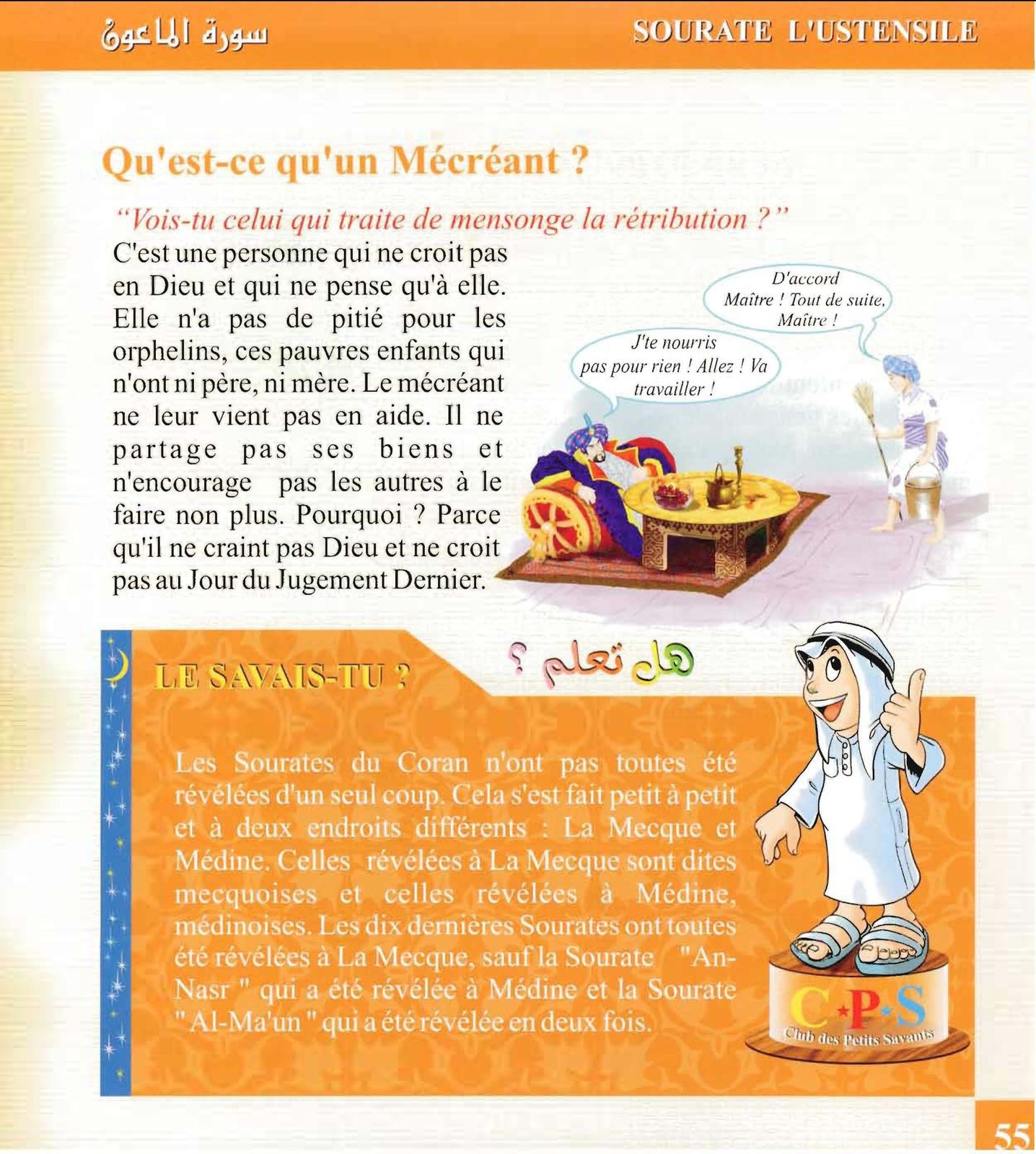
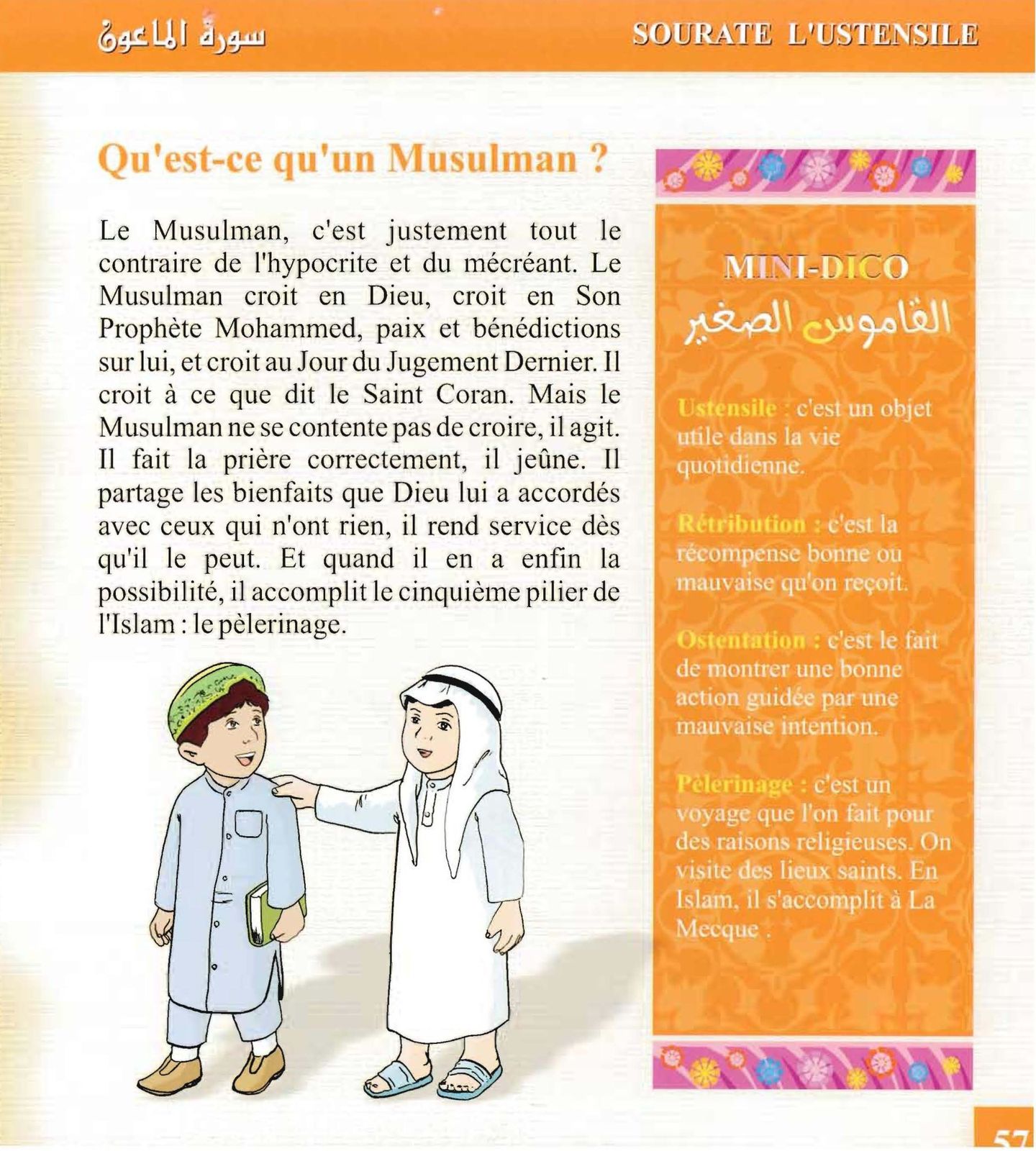
Sourate Al Ma'un pour les enfants


maoun

maoun2

maoun3

maoun4

maoun5

maoun6


sumber dari: baladislam.over-blog.com

Tafsir Tadabbur : Surat Al Ma’uun


أَرَأَيْتَ الَّذِي يُكَذِّبُ بِالدِّينِ V فَذَلِكَ الَّذِي يَدُعُّ الْيَتِيمَ V وَلَا يَحُضُّ عَلَى طَعَامِ الْمِسْكِينِ V فَوَيْلٌ لِلْمُصَلِّينَ V الَّذِينَ هُمْ عَنْ صَلَاتِهِمْ سَاهُونَ V الَّذِينَ هُمْ يُرَاءُونَ V وَيَمْنَعُونَ الْمَاعُونَ V

Tahukah kamu (orang) yang mendustakan agama? Itulah orang yang menghardik anak yatim. Dan tidak menganjurkan memberi makan orang miskin. Maka kecelakaanlah bagi orang-orang yang sholat. (yaitu) orang-orang yang lalai dari sholatnya. Orang-orang yang berbuat riya. Dan enggan (menolong dengan) barang berguna.


Sebab Turunnya Ayat

Al Wahidy[1] menuliskan dua pendapat mengenai siapakah orang yang dimaksud dalam ayat ini (1-2), muqatil dan al kalby berpendapat bahwa yang dimaksud adalah al ash bin wail as sahmy. menurut ibnu juraiz yang dimaksud adalah abu sufyan, “كَانَ أَبُو سُفْيَانَ بْنُ حَرْبٍ يَنْحَرُ كُلَّ أُسْبُوعٍ جَزُورَيْنِ، فَأَتَاهُمْ يَتِيمٌ فَسَأَلَهُ شَيْئًا فَقَرَعَهُ بِعَصَا”karena ia selalu menyembelih kambing atau unta setiap pekannya, tetapi ketika anak-anak yatim itu meminta kepadanya ia mengetuk kepala mereka dengan tongkatnya.

Riwayat lainnya dari ibnu abbas ra, yang disampaikan oleh adh dhahhak bahwa yang dimaksud adalah salah seorang dari kaum munafik. As suddi mengatakan bahwa maksudnya adalah al walid bin al mughirah, ada juga yang berpendapat bahwa yang dimaksud adalah abu jahal. [2]

Mengenai sebab turunnya ayat 4, az zuhaili menuliskan dalam tafsirnya sebagai berikut, diriwayatkan oleh ibnul mundzir dari ibnu abbas ra, bahwa (نُزِلَتْ فِي المُنَافِقِينَ كانُوا يُرَاءُونَ المُؤْمِنِينَ بِصَلاَتِهِمْ إِذَا حَضَرُوا، وَيَتْرَكُونَهَا إِذَا غَابُوا، وَيَمْنَعُونَهُمُ العَارِيَّةَ، أَيْ الشَّيءُ الْمُسْتَعَارُ) ayat ini turun terkait dengan orang munafiq yang mengerjakan sholat jika orang mukmin melihatnya, namun mereka meninggalkannya ketika sendirian, serta menahan meminjamkan sesuatu secara sukarela. [3]

Munasabah
            
Keterkaitan surat ini dengan surat sebelumnya (al quraisy) menurut as suyuti adalah (ذكر الله تعالى في سورة قريش: الَّذِي أَطْعَمَهُمْ مِنْ جُوعٍ، ذَكَرَ هُنَا ذَمَّ مَنْ لَمْ يَحُضْ عَلَى طَعَامِ المِسْكِينَ) jika pada surat al quraisy Allah mengingatkan kaum quraisy bahwa Ia lah yang memberi mereka makan untuk menghilangkan rasa lapar, maka pada surat ini Allah mengingatkan  dengan mencela mereka yang tidak menganjurkan memberi makan orang miskin. Kemudian (فَلْيَعْبُدُوا رَبَّ هَذَا الْبَيْتِ ذَكَرَ هُنَا مَنْ سَهَا عَنْ صَلاتِهِ) perintah menyembah Rabb ka’bah mengingatkan tentang mereka yang lalai dengan sholatnya.[4]

Al alusi menambahkan bahwa keterkaitan surat ini ialah (ذَمَّ سُبْحَانَهُ هُنَا لَمَّا عَدَدَ نِعْمَةَ تَعَالَى عَلَى قُرَيشٍ وَكَانُوا لَا يُؤْمِنُونَ باِلبَعْثِ وَالْجَزَاءِ) Allah mencela kaum quraisy dengan menyebutkan kenikmatan yang Ia limpahkan kepada mereka namun mereka tidak beriman kepada hari kebangkitan dan pembalasan.[5]
           
 Vأَرَأَيْتَ الَّذِي يُكَذِّبُ بِالدِّينِ V
Tahukah kamu (orang) yang mendustakan agama?

Ibnu Katsir menuliskan (أَرَأَيْتَ -يَا مُحَمَّدُ-  الَّذِي يُكَذِّبُ بِالدِّينِ؟ وَهُوَ: الْمَعَادُ وَالْجَزَاءُ وَالثَّوَابُ) Apakah kamu mengetahui hai Muhammad, orang yang mendustakan ad diin, yaitu hari kebangkitan serta pemberian balasan dan pahala?[6]

Demikian pula pendapat Ibnu Jarir ath thobari, pertanyaan yang ditujukan kepada Rasulullah saw ini berisi informasi para pendusta agama (أَرَأَيْتَ يَا مُحَمَّد الَّذِي يُكَذِّبُ بِثَوَابِ اللهِ وَعِقَابِهِ، فَلَا يُطِيعُهُ فِي أَمْرِهِ وَنَهْيِهِ) tahukah kamu hai Muhammad, orang yang mendustakan pahala dan siksa Allah, sehingga tidak mematuhi-Nya dalam hal perintah dan larangan-Nya.[7]

Ibnu abi hatim meriwayatkan dari ibnu abbas bahwa maksudnya ayat ini adalah (الَّذِي يُكَذِّبُ بِحُكْمِ اللهِ عَزَّ وَجَلَّ) yaitu yang mendustakan hukum Allah. Sedangkan al hasan mengartikan bahwa maksudnya adalah orang kafir.[8]

Al mawardi menuliskan tiga pendapat tentang pendusta agama yaitu (أحدها: يعني بالحساب , قاله عكرمة ومجاهد. الثاني: بحكم الله تعالى , قاله ابن عباس. الثالث: بالجزاء الثواب والعقاب) mereka yang mendustakan hisab, hukum Allah serta pahala dan hukuman.[9]

Sayyid quthb menuliskan bahwa (هَذَا الاِسْتِفْهَامُ الَّذِي يُوَجِّهُ كُلَّ مَنْ تَتَأَتَّى مِنْهُ الرُؤْيَةُ لِيَرَى وَيَنْتَظِرُ مَنْ يَسْمَعُ هَذَا الاِسْتِفْهَامِ لِيَرَى إِلَى أَيْنَ تَتَّجِهُ الإِشَارَةُ وَإِلَى مَنْ تَتَّجِهُ؟ وَمَنْ هُوَ هَذَا الَّذِي يُكَذِّبُ بِالدِّينِ، وَالَّذِي يُقَرِّرُ القُرْآنَ أَنَّهُ يُكَذِّبُ بِالدِّينِ) ini adalah pertanyaan yang ditujukan kepada setiap orang yang bisa melihat agar menyaksikan dan menantikan orang yang mendengar pertanyaan ini untuk melihat kemana isyarat ini di arahkan dan kepada siapa ditujukan? Siapakah orang yang mendustakan agama dan siapakah orang yang ditetapkan al qur’an sebagai pendusta agama. [10] Informasi karakteristik para pendusta agama itu Allah sebutkan dalam ayat-ayat selanjutnya.

V فَذَلِكَ الَّذِي يَدُعُّ الْيَتِيمَ V
Itulah orang yang menghardik anak yatim

Makna dari kata yadu’u pada ayat ini adalah (يَدْفَعُ) mendorong, sebagaimana tertera pada firman Allah ta’ala,
يَوْمَ يُدَعُّونَ إِلَى نَارِ جَهَنَّمَ دَعًّا
“pada hari mereka didorong ke neraka jahannam dengan sekuat-kuatnya” (ath thuur 13)[11]
            Ath thobari menafsirkan maksudnya adalah (هُوَ الَّذِي يَدْفَعُ اليَتِيمَ عَنْ حَقِّهِ، وَيَظْلِمُهُ) mereka yang mencegah anak yatim dari haknya dan menzhaliminya,[12] ibnu katsir mengatakan (هُوَ الَّذِي يَقْهَرُ الْيَتِيمَ وَيَظْلِمُهُ حَقَّهُ، وَلَا يُطْعِمُهُ وَلَا يُحْسِنُ إِلَيْهِ) mereka adalah orang yang berbuat sewenang-wenang kepada anak yatim dan menzhalimi haknya, tidak memberinya makan serta tidak berbuat baik pula kepadanya.[13]
            
Pengertian-pengertian tersebut di atas dapat kita temukan dalam riwayat-riwayat berikut,
            
Dari Ibnu Abbas ra, maksud ayat ini adalah (يَدْفَعُ حَقَّ اليَتِيمِ) mencegah anak yatim dari haknya.[14] Mujahid berkata (يَدْفَعُ الْيَتِيمَ، عَنْ حَقِّهِ وَيَظْلِمُهُ) menahan anak yatim dari haknya serta menzhaliminya.[15] Muhammad bin amru menceritakan dari mujahid bahwa maksudnya adalah (يَدْفَعُ اليَتِيمَ فَلَا يُطعِمْهُ) mencegah anak yatim sehingga tidak memberinya makan.[16]
            
Pengertian-pengertian tersebut diatas saling terkait, al qurthubi mendefiniskan pengertiannya dengan lebih praktis yang dimaksud adalah (أَنَّهُمْ كَانُوا لَا يُوَرِّثُونَ النِّسَاءَ وَلَا الصِّغَارَ) mereka yang tidak memberikan harta warisan kepada wanita dan anak-anak kecil (yatim) apa yang sudah menjadi haknya.[17]

Hamka berpendapat pemakaian kata yadu’u yang berarti menolak maksudnya adalah menolakkannya dengan tangan apabila ia mendekat. Hal ini mencerminkan kebencian yang sangat, rasa tidak senang, rasa jijik dan tidak boleh mendekat. Sehingga benarlah mereka yang membenci anak yatim itu pendusta agama.[18]
            
Dari Malik bin Amru, Rasulullah saw pernah bersabda,

وَمَنْ ضَمَّ يَتِيمًا بَيْنَ أَبَوَيْنِ مُسْلِمَيْنِ إِلَى طَعَامِهِ وَشَرَابِهِ حَتَّى يُغْنِيَهُ اللَّهُ، وَجَبَتْ لَهُ الْجَنَّةُ

Barangsiapa yang merangkul (memelihara) seorang anak yatim yang berasal dari keluarga muslim dengan memberinya makan dan minum hingga Allah menjadikan anak tersebut berkecukupan, maka orang tersebut berhak untuk masuk kedalam surga.[19]
           
V وَلَا يَحُضُّ عَلَى طَعَامِ الْمِسْكِينِ V
Dan tidak menganjurkan memberi makan orang miskin
           
            Maksudnya adalah (وَلَا يَحُثُّ غَيْرُهُ عَلَى إِطْعَامِ المُحْتَاجِ مِنَ الطَعَامِ) tidak mendorong orang lain untuk memberikan makanan kepada orang yang membutuhkan.[20] Al qurthubi berpendapat (لَا يَفْعَلُونَهُ إِنْ قَدَرُوا، وَلَا يَحُثُّونَ عَلَيْهِ إِنْ عَسِرُوا) mereka tidak mau berbagi meski mereka mampu dan apabila mereka tidak mampu mereka tidak menganjurkan orang lain untuk berbagi.[21]

Ibnu katsir menuliskan bahwa ayat ini semisal dengan firman Allah ta’ala dalam surat al fajr 17-18:
كَلا بَل لَا تُكْرِمُونَ الْيَتِيمَ وَلا تَحَاضُّونَ عَلَى طَعَامِ الْمِسْكِينِ
“Sekali-kali tidak (demikian), sebenarnya kamu tidak memuliakan anak yatim, dan kamu tidak saling mengajak memberi makan orang miskin”
            
Hamka berpendapat dalam tafsirnya bahwa semestinyalah seorang ayah mendidik anak dan istrinya untuk menyediakan makanan bagi yang membutuhkan. Serta menjadikan kegiatan ajak mengajak, galak menggalakkan dalam rangka menolong anak yatim dan fakir miskin menjadi perasaan bersama dan budi pekerti yang umum.[22]
            
Makna yang demikian juga dikemukakan sayyid quthb dengan tegas (إِنَّ حَقِيْقَةَ التَّصْدِيقِ بِالدِّينِ لَيْسَتَ كَلِمَةً تُقَالُ بِاللِسَانِ إِنَّمَا هِيَ تُحَوِّلُ فِي الْقَلْبِ يَدْفَعُهُ إِلىَ الخَيْرِ وَالبِرِّ بِإِخْوَانِهِ فِي البَشَرِيَّةِ، اَلْمُحْتَاجِينَ إِلَى الرِعَايَةِ وُالْحِمَايَةِ) sesungguhnya hakikat membenarkan agama itu tidak sekedar ucapan lisan semata, melainkan berproses dalam hati hingga mendorongnya untuk melakukan kebaikan dan kebenaran kepada saudaranya sesama ummat manusia yang membutuhkan perlindungan dan perawatan.[23]

V فَوَيْلٌ لِلْمُصَلِّينَ V الَّذِينَ هُمْ عَنْ صَلَاتِهِمْ سَاهُونَ V
Maka kecelakaanlah bagi orang-orang yang sholat. (yaitu) orang-orang yang lalai dari sholatnya

            Al wail adalah (الوَادِي الَّذِي يَسِيلُ مِنْ صَدِيدِ أَهْلِ جَهَنَّمِ لِلْمُنَافِقِينَ الَّذِيَن يُصَلُّونَ، لَا يُرِيدُونَ اللهَ عَزَّ وَجَلَّ بِصَلَاتِهِمْ، وَهُمْ فِي صَلَاتِهِمْ سَاهُونَ إِذَا صَلُّوهَا) lembah yang dialiri oleh nanah para penghuni jahannam, diperuntukkan bagi orang-orang munafik yang mengerjakan sholat tapi dengan sholat itu mereka tidak menginginkan Allah dan mereka lalai dalam sholatnya.[24] Al qurthubi mengatakan bahwa  makna al wail adalah adzab.[25]
            
Ath thabari menuliskan dalam tafsirnya bahwa para ahli tafsir berbeda pendapat tentang maksud orang-orang yang lalai dari sholatnya, sebagian mengatakan bahwa maksudnya adalah (أَنَّهُمْ يَؤَخِّرُونَهَا عَنْ وَقْتِهَا، فَلاَ يُصَلُّونَهَا إِلَّا بَعْدَ خُرُوجِ وَقْتِهَا) mereka yang menunda-nunda pelaksanaan dari waktunya, sehingga mereka tidak mengerjakannya kecuali setelah keluar dari waktunya. Sedangkan yang lain berpendapat (أَنَّهُمْ يَتْرَكُونَهَا فَلَا يُصَلُّونَهَا) meninggalkannya serta tidak mengerjakan sholat. Pendapat terakhir adalah (أَنَّهُم يَتَهَاوَنُونَ بِهَا، وَيَتَغَافَلُونَ عَنْهَا وَيَلْهُونَ) mereka meremehkannya, melalaikannya dan menyia-nyiakannya.[26]
            
Menurut al qurthubi makna ayat ini sesuai dengan firman Allah ta’ala dalam surat an nisa 142:

إِنَّ الْمُنَافِقِينَ يُخَادِعُونَ اللَّهَ وَهُوَ خَادِعُهُمْ وَإِذَا قَامُوا إِلَى الصَّلَاةِ قَامُوا كُسَالَى يُرَاءُونَ النَّاسَ وَلَا يَذْكُرُونَ اللَّهَ إِلَّا قَلِيلًا
Sesungguhnya orang-orang munafik itu menipu Allah dan Allah akan membalas tipuan mereka. Dan apabila mereka berdiri untuk sholat mereka berdiri dengan malas. Mereka bermaksud riya (dengan sholat) di hadapan manusia. Dan tidaklah mereka menyebut (mengingat) Allah kecuali sedikit.
            
Imam muslim meriwayatkan dari anas bin malik ra, Rasulullah saw bersabda:

تِلْكَ صَلَاةُ الْمُنَافِقِ، يَجْلِسُ يَرْقُبُ الشَّمْسَ حَتَّى إِذَا كَانَتْ بَيْنَ قَرْنَيِ الشَّيْطَانِ، قَامَ فَنَقَرَهَا أَرْبَعًا، لَا يَذْكُرُ اللهَ فِيهَا إِلَّا قَلِيلًا
Itu adalah sholat orang munafiq, ia duduk menunggu matahari hingga matahari berada diantara dua tandung syaitan, lalu ia berdiri lalu naik dan turun empat kali, tidak mengingat Allah dalam sholatnya kecuali sedikit.[27]
            
Lebih lanjut al qurthubi menuliskan pendapat ibnu abbas (وَلَوْ قَالَ فِي صَلَاتِهِمْ سَاهُونَ لَكَانَتْ فِي الْمُؤْمِنِينَ)bahwa seandainya yang disebutkan dalam surat ini adalah fii sholatihim saahun, maka yang dimaksud adalah orang-orang beriman. Demikian pula pendapat atha,( الْحَمْدُ لِلَّهِ الَّذِي قَالَ عَنْ صَلاتِهِمْ وَلَمْ يَقُلْ فِي صَلَاتِهِمْ) Alhamdulillah bahwa yang disebutkan adalah ‘an sholatihim. Sebab jika disebutkan fii sholatihim adalah mereka yang terlupa dalam sholatnya tanpa disengaja baik karena bisikan setan maupun dari dalam dirinya sendiri, sedang hal tersebut adalah manusiawi.[28]

V الَّذِينَ هُمْ يُرَاءُونَ V
Orang-orang yang berbuat riya.

            Makna hakiki dari kata riya adalah (طَلَبُ مَا فِي الدُّنْيَا بِالْعِبَادَةِ، وَأَصْلُهُ طَلَبُ الْمَنْزِلَةِ فِي قُلُوبِ النَّاسِ) mengharapkan sesuatu yang bersifat duniawi melalui ibadah. Dan makna awal dari kata ini adalah mencari kedudukan di hati manusia.[29] Ath thobari berpendapat bahwa mereka mengerjakan sholat bukan karena menginginkan pahala dan takut terhadap siksa melainkan agar dilihat orang beriman dan dikira termasuk kalangan mereka, sehingga darah, harta, anak-anak serta wanita-wanita mereka terlindung.[30]
            
Ath thabrani meriwayatkan dari ibnu abbas tentang ancaman bagi orang-orang yang riya. Rasulullah saw bersabda:

إِنَّ فِي جَهَنَّمَ لَوَادِيًا يَسْتَعِيذُ جَهَنَّمُ مِنْ ذَلِكَ الْوَادِي فِي كُلِّ يَوْمٍ أَرْبَعَمِائَةِ مَرَّةٍ أُعِدَّ ذَلِكَ الْوَادِي لِلْمُرَائِينَ مِنْ أُمَّةِ مُحَمَّدٍ صَلَّى اللهُ عَلَيْهِ وَسَلَّمَ: لِحَامِلِ كِتَابِ اللهِ، وَلِلْمُصَّدِّقِ فِي غَيْرِ ذَاتِ اللهِ، وَلِلْحُجَّاجِ إِلَى بَيْتِ اللهِ، وَلِلْخَارِجِ فِي سَبِيلِ اللهِ.
“sesungguhnya di neraka jahannam terdapat sebuah lembah, dimana jahannam itu selalu berlindung dari lembah tersebut setiap hari hinggga 400 kali. Lembah tersebut disediakan untuk orang-orang riya dari ummat Muhammad saw, bagi orang yang membawa kitabullah dan orang yang bersedekah bukan karena Allah, juga bagi orang yang beribadah haji ke baitullah serta bagi orang yang keluar di jalan Allah.[31]
           
V وَيَمْنَعُونَ الْمَاعُونَ V
Dan enggan (menolong dengan) barang berguna

Asal makna al ma’un adalah (مِنْ كُلِّ شيءٍ مَنْفَعَتِهِ) segala sesuatu yang bermanfaat.[32] Al qurthubi menuliskan bahwa makna ayat ini terdapat dua belas pendapat dari para ulama. Secara ringkas sebagai berikut, zakat, harta, peralatan rumah tangga, segala sesuatu yang ada manfaatnya, angin dingin atau hawa dingin, segala kebajikan yang dilakukan sesama manusia, air dan rerumputan, air, orang yang menolak kebenaran, seseorang yang menginvestasikan hartanya, ketaatan, sesuatu yang tidak boleh tidak diberikan apabila diminta.[33] Al mawardi berkata (وَيَحْتَمِلُ أَنَّهُ الْمَعُونَةُ بِمَا خَفَّ فِعْلُهُ وَقَدْ ثَقَّلَهُ اللَّهُ) kemungkinan besar bantuan-bantuan in sebenarnya ringan untuk dilakukan, namun disulitkan dan diberatkan Allah khusus bagi mereka (orang munafik).[34]

Al qurthubi menutup pembahasan surat ini dengan menuliskan bahwa surat ini tepat sekali jika ditujukan kepada kaum munafiq. Makna ini sesuai dengan firman Allah ta’ala dalam surat an nisa 142,

إِنَّ الْمُنَافِقِينَ يُخَادِعُونَ اللَّهَ وَهُوَ خَادِعُهُمْ وَإِذَا قَامُوا إِلَى الصَّلَاةِ قَامُوا كُسَالَى يُرَاءُونَ النَّاسَ وَلَا يَذْكُرُونَ اللَّهَ إِلَّا قَلِيلًا
“Sesungguhnya orang-orang munafik itu menipu Allah dan Allah akan membalas tipuan mereka. Dan apabila mereka berdiri untuk sholat mereka berdiri dengan malas. Mereka bermaksud riya (dengan sholat) di hadapan manusia. Dan tidaklah mereka menyebut (mengingat) Allah kecuali sedikit.”

Dan surat at taubah 54,

وَلَا يَأْتُونَ الصَّلَاةَ إِلَّا وَهُمْ كُسَالَى وَلَا يُنْفِقُونَ إِلَّا وَهُمْ كَارِهُونَ
“Dan mereka tidak mengerjakan sholat melainkan dengan malas dan tidak pula menafkahkan (harta) mereka melainkan dengan rasa enggan”.

Hikmah

1.         Ayat ini mencela para pendusta agama secara umum --  dengan karakteristik yang disebutkan dalam ayat -- karena tidak dibatasi oleh sebab turunnya ayat secara khusus.( اَلْعِبْرَةُ بِعُمُومِ اللَفْظِ لاَ بِخُصُوصِ السَبَبِ)

2.         Islam adalah diin yang sempurna, menyatukan aspek pribadi dan sosial maupun antara amal-amal hati, fikiran, lisan dan perbuatan. Tidak cukup seseorang itu rajin beribadah secara pribadi namun buruk hubungannya dengan sesamanya. Sebagaimana tidak cukup secara lahiriyah seorang itu terlihat tunduk dan patuh kepada Allah sedangkan hatinya tidak berharap kepada Allah. Begitu pula sebaliknya.

3.         Hakikat ibadah berupa perintah dan larangan adalah untuk kebaikan bagi manusia, ibnu katsir[35] berpendapat bahwa ibadah adalah sumber kebahagiaan dan ketenangan hati. Proses manusia menempuh ujian dalam menepati perintah dan larangan Allah akan menjadikannya berbahagia, karena ibadahlah hakikat kehidupan yang sesungguhnya.
            
Sayyid quthb menegaskan makna yang serupa dalam tafsirnya ia menyebutkan,

إِنَّ اللهَ لاَ يُرِيدُ مِنْهُمْ شَيْئًا لِذَاتِهِ سُبْحَانَهُ- فَهُوَ الغَنِيُ- إِنَّمَا يُرِيدُ صَلَاحَهُم هُمْ أَنْفُسَهُمْ. يُرِيدُ الخَيْرَ لَهُم. يُرِيدُ طَهَارَةَ قُلُوبِهِمْ وَيُرِيدُ سَعَادَةَ حَيَاتِهِم. يُرِيدُ لَهُمْ حَيَاةَ رَفِيعَةِ قَائِمَةٍ عَلَى الشُعُورِ النَظِيفِ، وَالتَكَافُلِ الجَمِيلِ، وَالأَرِيحِيَةِ الْكَرِيمَةِ وَالحُبِّ وَالْإِخَاءِ وَنَظَافَةِ القَلْبِ وَالسُلُوكِ
Sesungguhnya Allah tidak menghendaki sesuatu dari mereka untuk diri-Nya Yang Maha Suci – karena Dia Maha Kaya – tetapi Dia menginginkan kebaikan dan kemaslahatan manusia sendiri. Menginginkan kebaikan bagi mereka. Menginginkan kesucian hati dan kebahagiaan hidup mereka. Menginginkan bagi mereka kehidupan yang tinggi berasaskan perasaan yang bersih, saling menanggung beban dengan baik, kemurahan hati yang mulia, cinta dan persaudaraan  serta kebersihan hati dan perilaku.[36]
Wallahu a’lam


sumber dari: sigitsuhandoyo.blogspot.com